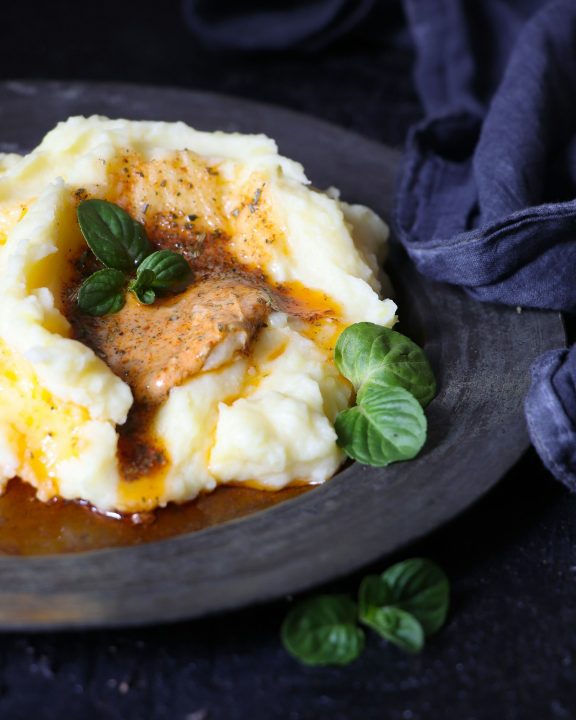
Healthy mashed potatoes don’t have to taste like a compromise. This version keeps real Yukon Gold potatoes and real butter, just two tablespoons for the whole pot instead of the usual stick, and gets its creaminess from thick Greek yogurt. Each serving is about 213 calories with 6.5 g of protein, and nobody at the table will clock it as the “light” mash.
The trick is less about what you remove and more about what you add back: garlic cooked right in the pot, salty potato water instead of milk, and yogurt stirred in off the heat so it stays silky instead of grainy.
Healthy mashed potatoes recipe
Prep: 10 minutes · Cook: 25 minutes · Total: 35 minutes · Serves: 6 (about 1 cup each)
Ingredients
- 2 1/2 lb (1.1 kg) Yukon Gold potatoes, peeled and cut into 2-inch chunks
- 4 garlic cloves (12 g), peeled
- 1 tbsp salt, for the cooking water
- 3/4 cup (170 g) plain nonfat Greek yogurt, at room temperature
- 2 tbsp (28 g) salted butter
- 1/2 to 3/4 cup reserved potato cooking water
- 1/2 tsp salt, plus more to taste
- 1/4 tsp black pepper
- 2 tbsp (6 g) chopped chives
Method
- Put the potatoes and garlic in a large pot, cover with cold water by 1 inch and add 1 tbsp salt.
- Bring to a boil, then lower to a steady simmer and cook for 15 to 20 minutes, until a knife slides into the biggest chunk with no resistance.
- Scoop out 1 cup of the cooking water, then drain the potatoes and garlic. Return them to the hot pot over low heat for 1 to 2 minutes, shaking the pot, so the surface moisture steams off.
- Turn off the heat. Add the butter and mash the potatoes and garlic with a hand masher, or press them through a ricer.
- Stir in the Greek yogurt, 1/2 tsp salt and the pepper, then add the reserved cooking water a splash at a time until the mash is as loose as you like.
- Taste, adjust the salt and top with the chives just before serving.
Per serving (1/6 of the batch): 213 calories, 6.5 g protein, 38.6 g carbs, 4.1 g fat, 3.4 g fiber. The salt in the cooking water mostly drains away and isn’t counted.
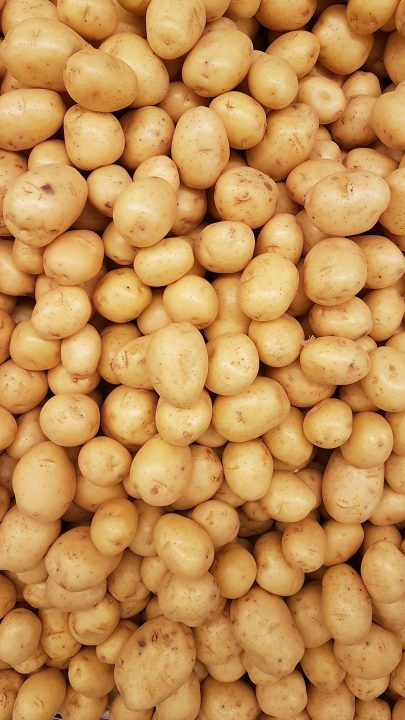
Why Greek yogurt works in mashed potatoes
Classic mashed potatoes lean on butter and cream for two things: richness and a little tang-free smoothness. Greek yogurt covers the smoothness and adds a gentle tang that plays the same role sour cream does in a loaded baked potato. Plain nonfat Greek yogurt has about 59 calories and 10 g of protein per 100 g, so 3/4 cup adds body and protein for very little.
Three details keep it from going wrong:
- Let the yogurt warm up. Take it out of the fridge when you start peeling. Cold yogurt cools the mash fast and makes it stiff.
- Add it off the heat. Yogurt can turn grainy if it simmers. Stir it in once the burner is off and the potatoes are already mashed.
- Use potato water, not milk. The starchy, salted cooking water loosens the mash and seasons it at the same time. It’s free flavor, and it adds no calories worth counting.
My honest take: if you cut the butter to zero, you’ll taste it. Two tablespoons spread over six servings is the point where the mash still tastes buttery, and it’s where I’d stop trimming.
The best potatoes for healthy mashed potatoes
Yukon Golds are the best choice when you’re using less fat. They’re naturally creamy and a little buttery-tasting, so they need less help than other potatoes. Here’s how the common options compare:
 You’ll also loveHow to Make Turkey Soup From the Thanksgiving Carcass
- Yukon Gold: creamy, dense and golden. Holds up to a hand masher and doesn’t get gluey easily. The one to use here.
- Russet: fluffy and light, but drier. With only a little butter they can taste flat, so add a bit more potato water and yogurt.
- Red potatoes: waxy, best for a chunky, skin-on “smashed” style. They won’t go fully smooth.
Want to keep the skins on? Scrub Yukon Golds well, leave them unpeeled and mash by hand for a rustic texture. Skip the ricer in that case, since the skins will clog it.
Healthy vs classic mashed potatoes: the numbers
All three columns use the same 2 1/2 lb of potatoes, 4 garlic cloves and chives, split into 6 servings. The classic version uses a full stick of butter (1/2 cup) and no yogurt, loosened with potato water.
| Per serving | Classic (1 stick butter) | This recipe | Extra-light |
|---|---|---|---|
| Butter / yogurt | 8 tbsp / none | 2 tbsp / 3/4 cup | 1 tbsp / 1 cup |
| Calories | 298 | 213 | 202 |
| Protein | 3.7 g | 6.5 g | 7.5 g |
| Carbs | 37.6 g | 38.6 g | 38.9 g |
| Fat | 15.5 g | 4.1 g | 2.2 g |
| Fiber | 3.4 g | 3.4 g | 3.4 g |
The carbs barely change, because they come from the potatoes. What drops is the fat: from 15.5 g to 4.1 g per serving, which accounts for almost all of the 85-calorie difference. The extra-light version saves only about 11 more calories, so unless you really need it, I’d stay with the main recipe for flavor.
Low calorie mashed potato variations
- Extra-light: 1 tbsp butter and 1 cup (227 g) Greek yogurt, as in the table. Tangier, still creamy.
- Roasted garlic: skip the boiled cloves and squeeze in half a head of roasted garlic. Deeper and sweeter, great next to turkey.
- Olive oil and herbs: swap the butter for 2 tbsp olive oil and fold in parsley and a little lemon zest. Dairy-light, and only about 6 calories more per serving than the butter version.
- Half cauliflower: replace half the potatoes with steamed cauliflower for fewer carbs. Our cauliflower mashed potatoes walk through the half-and-half method and how to keep it from turning watery.
- Skin-on smashed: unpeeled Yukon Golds or red potatoes, mashed roughly, with extra chives and black pepper.
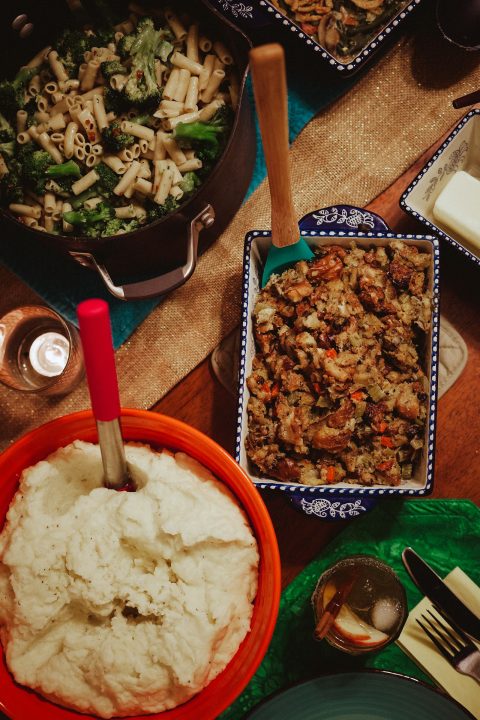
Making mashed potatoes ahead for Thanksgiving
Mashed potatoes are one of the most stressful sides on the big day because they’re usually made last, while the turkey rests. You can make this batch up to two days ahead instead. Cool it quickly, then refrigerate it in a covered container.
The FoodSafety.gov cold storage chart doesn’t list mashed potatoes by name, but its leftovers entries, such as cooked meat and soups with vegetables, all sit at 3 to 4 days in the fridge at 40°F or below. That’s the window I’d use here.
- Oven: spread into a baking dish, dot with a teaspoon of butter or a splash of potato water, cover with foil and warm at 350°F for 25 to 30 minutes, stirring once.
- Slow cooker: keep it on low with the lid on, and stir in a splash of warm water or milk every hour. Handy when the oven is full.
- Microwave: heat in 1-minute bursts, stirring between each, until hot all the way through.
Yogurt-based mash firms up in the fridge, so expect to loosen it with a little liquid when you reheat. It can be frozen too, but the texture comes back slightly grainier; a good stir over low heat helps.
Common mistakes that make mash gluey or bland
- Using a food processor or blender. The blades break the starch cells and turn potatoes into glue. A hand masher or ricer is all you need.
- Not drying the potatoes. That 1 to 2 minutes back in the hot pot drives off water so the mash takes in flavor instead of tasting diluted.
- Uneven chunks. Small pieces fall apart while big ones stay hard in the middle. Cut everything close to 2 inches.
- Underseasoning. With less butter, salt matters more. Salt the cooking water well, then taste at the end and adjust.
- Overmixing after the yogurt goes in. Stir just until combined. Extra beating makes the texture pasty.
What to serve with healthy mashed potatoes
On Thanksgiving, this mash fits straight into our make-ahead healthy Thanksgiving sides, next to the balsamic Brussels sprouts and a spoonful of low sugar cranberry sauce. If you want a second potato dish, the healthy sweet potato casserole can bake while the potatoes simmer.
On a regular weeknight, serve it under baked turkey meatballs or next to roast chicken and a green vegetable. Since the mash itself is modest in protein, a lean main turns it into a balanced plate.
Sources
- Nutrition per 100 g from USDA FoodData Central (SR Legacy), via GetFoodFacts and FDC: potatoes, boiled, flesh (FDC 170438), Greek yogurt, plain, nonfat (FDC 170894), butter, salted (FDC 173410), garlic, raw (FDC 169230), chives, raw (FDC 169994), olive oil (FDC 171413).
- Storage times: FoodSafety.gov, Cold Food Storage Charts.


21 meals, 100 g+ protein a day, plus a grocery list and prep schedule.
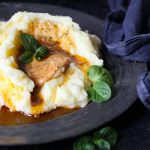
Healthy Mashed Potatoes
Ingredients
- 2 1/2 lb (1.1 kg) Yukon Gold potatoes, peeled and cut into 2-inch chunks
- 4 garlic cloves (12 g), peeled
- 1 tbsp salt, for the cooking water
- 3/4 cup (170 g) plain nonfat Greek yogurt, at room temperature
- 2 tbsp (28 g) salted butter
- 1/2 to 3/4 cup reserved potato cooking water
- 1/2 tsp salt, plus more to taste
- 1/4 tsp black pepper
- 2 tbsp (6 g) chopped chives
Instructions
- Put the potatoes and garlic in a large pot, cover with cold water by 1 inch and add 1 tbsp salt.
- Bring to a boil, then lower to a steady simmer and cook for 15 to 20 minutes, until a knife slides into the biggest chunk with no resistance.
- Scoop out 1 cup of the cooking water, then drain the potatoes and garlic. Return them to the hot pot over low heat for 1 to 2 minutes, shaking the pot, so the surface moisture steams off.
- Turn off the heat. Add the butter and mash the potatoes and garlic with a hand masher, or press them through a ricer.
- Stir in the Greek yogurt, 1/2 tsp salt and the pepper, then add the reserved cooking water a splash at a time until the mash is as loose as you like.
- Taste, adjust the salt and top with the chives just before serving.
Nutrition per about 1 cup
21 meals, 100 g+ protein a day, plus a grocery list and prep schedule.