Short answer: The best breakfast meal prep ideas are the ones that hold up for days: egg muffin cups, freezer breakfast burritos, overnight oats, chia pudding, baked oatmeal and hard-boiled egg snack boxes. Cooked egg dishes keep 3–4 days in the fridge and 2–3 months in the freezer, and hard-boiled eggs keep a week (according to FoodSafety.gov), so one hour on Sunday can cover most of your weekday breakfasts.
Weekday mornings are when good intentions fall apart. You’re short on time, you grab whatever is fastest, and by 10 a.m. you’re hungry again.
Breakfast meal prep fixes that with one simple trade: an hour of cooking on the weekend for five mornings where breakfast is already done. The trick is choosing recipes that actually survive the week — some breakfasts reheat beautifully, others turn soggy by Tuesday.
Below are 10 ideas that hold up, with protein counts calculated from USDA FoodData Central and storage times from the U.S. government’s FoodSafety.gov charts. Where a recipe includes ingredients we didn’t count (tortillas, fruit, sweeteners), the real protein total will be a little higher.
How long meal-prepped breakfasts keep
Before you cook a big batch, it helps to know how long each type of food stays good. These are the official guidelines from FoodSafety.gov’s cold food storage chart:
| Food | Fridge | Freezer |
|---|---|---|
| Casseroles with eggs (egg muffins, breakfast bakes) | 3–4 days after baking | 2–3 months |
| Quiche with filling | 3–5 days after baking | 2–3 months |
| Hard-cooked eggs | 1 week | Do not freeze |
| Fully cooked sausage | 1 week | 1–2 months |
| Cooked meat or poultry | 3–4 days | 2–6 months |
In practice, that means a simple rule: fridge for the next three or four days, freezer for everything after that. If you prep on Sunday, put Monday-through-Wednesday portions in the fridge and freeze the rest.
10 breakfast meal prep ideas
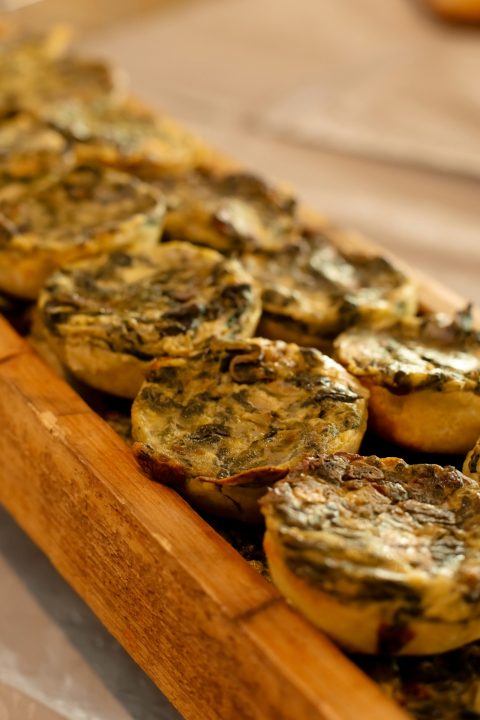
1. Egg muffin cups (~25 g protein per 3 cups)
This is the classic for a reason. Whisk a dozen eggs with chopped spinach, peppers and onion, pour into a greased 12-cup muffin tin, top with shredded cheddar and bake until set.
Each cup holds one large egg, which gives about 6.3 g of protein (USDA lists whole egg at 12.6 g per 100 g, and a large egg weighs about 50 g). Three cups plus the ounce of cheddar spread across them come to roughly 25 g.
They keep 3–4 days in the fridge and 2–3 months in the freezer. Reheat in the microwave for 30–60 seconds.
2. Freezer breakfast burritos (~23 g protein each)
Scramble two eggs (12.6 g), add a quarter cup of black beans (3.6 g) and an ounce of cheddar (6.5 g), and roll everything into a tortilla. That’s about 23 g of protein before you count the tortilla.
Let the filling cool completely before you wrap each burrito in foil or parchment — warm filling makes the tortilla soggy. They freeze for 2–3 months. Reheat straight from frozen in the microwave (unwrap the foil first) or in the oven.
3. Overnight oats with Greek yogurt (~23 g protein)
Stir together half a cup of rolled oats (5.4 g), half a cup of 2% milk (4.1 g), 100 g of plain Greek yogurt (10.2 g) and two tablespoons of chia seeds (3.3 g). That’s about 23 g of protein in a jar you don’t have to cook.
Mix a batch of four jars at once and add fresh fruit the morning you eat them. Overnight oats get softer each day, so if you like some texture, eat them within three or four days.
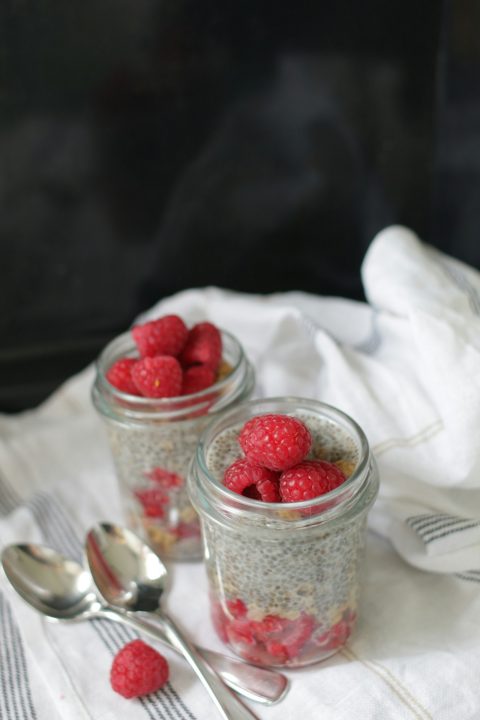
4. Vanilla chia pudding (~22 g protein)
Two tablespoons of chia seeds (3.3 g), a cup of 2% milk (8.3 g) and 100 g of Greek yogurt (10.2 g) set into a thick pudding overnight. Add a little vanilla and top with berries.
Chia on its own isn’t a big protein source — it’s the milk and yogurt doing most of the work here. For more on seeds and what they add, see our guide to 8 super seeds and their health benefits.
5. Hard-boiled egg snack boxes (~19 g protein)
Boil a dozen eggs on Sunday and build simple boxes: two eggs (12.6 g), an ounce of cheddar cubes (6.5 g), some fruit and a handful of nuts.
Hard-cooked eggs last a full week in the fridge, which makes them one of the longest-lasting prep options. The one thing you can’t do is freeze them — FoodSafety.gov advises against it, and the whites turn rubbery.
6. Sheet-pan breakfast frittata (~19 g protein per slice)
If muffin cups feel fiddly, bake the same mixture in a single sheet pan and cut it into squares. Plan for two eggs and about an ounce of cheese per serving, which works out to roughly 19 g of protein a slice.
It follows the same storage rules as egg casseroles: 3–4 days in the fridge, 2–3 months in the freezer.
7. Baked oatmeal squares (~13 g protein)
Mix rolled oats with milk, eggs, mashed banana and cinnamon, bake in a dish and slice into squares. A serving made with half a cup of oats (5.4 g), half a cup of milk (4.1 g) and half an egg (3.2 g) lands around 13 g of protein.
It’s lower in protein than the egg-based options, so pair a square with a cup of Greek yogurt or a glass of milk if you need more staying power.
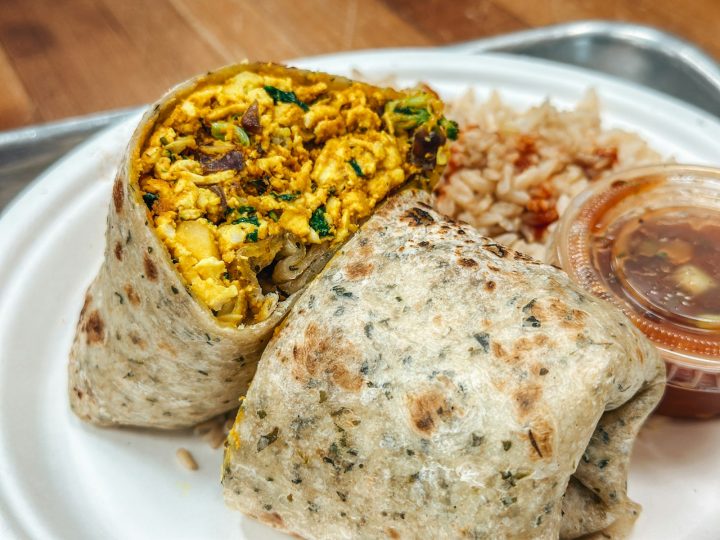
8. Tofu scramble burritos (~25 g protein, plant-based)
For a vegan freezer burrito, swap the eggs for half a cup of crumbled firm tofu (21.8 g) seasoned with turmeric and garlic, plus a quarter cup of black beans (3.6 g). That’s about 25 g of protein.
Wrap and freeze them exactly like the egg version. If you’re cutting eggs out entirely, we have a full list of high-protein breakfasts without eggs.
9. Cottage cheese breakfast boxes (~12 g protein)
Half a cup of 2% cottage cheese has about 11.8 g of protein. Portion it into containers with berries or pineapple on the side so the fruit doesn’t get watery, and add a sprinkle of seeds before eating.
Use the date on the tub as your guide, and keep these toward the start of the week.
10. Freezer smoothie packs (~25 g protein)
Fill freezer bags with frozen fruit, a handful of spinach and three tablespoons of hemp seeds (9.5 g). In the morning, tip one into the blender with a cup of 2% milk (8.3 g) and two tablespoons of peanut butter (7.2 g). That’s about 25 g of protein.
Lay the bags flat so they freeze in thin sheets and blend faster. For more flavor ideas, try our morning smoothies that boost mood and focus.
Breakfast meal prep ideas compared
| Idea | Protein per serving | Fridge | Freezer |
|---|---|---|---|
| Egg muffin cups (3) | ~25 g | 3–4 days | 2–3 months |
| Freezer breakfast burrito | ~23 g | 3–4 days | 2–3 months |
| Overnight oats with Greek yogurt | ~23 g | 3–4 days | Not ideal |
| Vanilla chia pudding | ~22 g | 3–4 days | Not ideal |
| Hard-boiled egg snack box | ~19 g | 1 week | Do not freeze |
| Sheet-pan frittata | ~19 g | 3–4 days | 2–3 months |
| Baked oatmeal squares | ~13 g | 3–4 days | 2–3 months |
| Tofu scramble burrito | ~25 g | 3–4 days | 2–3 months |
| Cottage cheese box | ~12 g | Per package date | Not ideal |
| Freezer smoothie pack | ~25 g | — | Store frozen |
Protein calculated from USDA FoodData Central per-100 g values (sources at the end). Fridge and freezer times for cooked egg dishes, hard-cooked eggs and cooked meat come from FoodSafety.gov; the overnight oats and chia pudding times are our practical recommendation for texture and freshness.
How to plan a week in about an hour
You don’t need to make all ten. Pick two or three and rotate them:
- Choose one hot option and one cold option. For example, egg muffin cups plus overnight oats. Having both keeps the week from getting boring.
- Cook the oven item first. While the muffin cups or frittata bake, mix your jars of oats or chia pudding.
- Boil a dozen eggs at the same time. They’re your backup breakfast and an easy snack.
- Split by day. Monday-to-Wednesday portions go in the fridge; Thursday and Friday go in the freezer.
- Label everything with the date. It sounds fussy, but it’s the easiest way to stick to the 3–4 day rule.
Food safety tips for breakfast meal prep
- Cool food quickly. Get cooked food into the fridge within two hours, and use small, shallow containers so it cools evenly (Food Safety News, citing USDA guidance).
- Reheat until steaming. The same USDA guidance recommends reheating leftovers to an internal temperature of 165°F.
- Freeze in single portions. Wrapping each burrito or frittata square individually means you only thaw what you need.
- Keep wet and crunchy separate. Add granola, nuts and fresh fruit on the day so they stay crisp.
If mornings still leave you dragging even after a solid breakfast, our piece on foods that fight fatigue without caffeine is worth a read.
FAQ
How long does breakfast meal prep last in the fridge?
Most cooked breakfast dishes, like egg muffins, frittatas and breakfast bakes, last 3–4 days in the fridge, according to FoodSafety.gov. Hard-boiled eggs last a week. Anything you won’t eat within that window should go in the freezer.
Can you freeze egg muffins and breakfast burritos?
Yes. Cooked egg dishes keep 2–3 months in the freezer. Let them cool fully, wrap them individually, and reheat straight from frozen.
What is the best high-protein breakfast to meal prep?
Egg muffin cups, freezer breakfast burritos and tofu scramble burritos all land around 23–25 g of protein per serving. Overnight oats made with Greek yogurt get close at about 23 g without any cooking.
Can you freeze hard-boiled eggs?
No. FoodSafety.gov advises against freezing hard-cooked eggs. Keep them in the fridge and eat them within a week.
Do overnight oats go bad?
They don’t spoil overnight, but they do get softer every day. For the best texture, make them in batches you’ll finish within three or four days, and add fresh fruit the morning you eat them.
Sources
Storage times: FoodSafety.gov — Cold Food Storage Charts
Cooling and reheating: Food Safety News — tips for safe leftovers (USDA guidance)
Protein values were calculated from per-100 g data in USDA FoodData Central:
- Egg, whole, raw, fresh — FDC 171287 (12.6 g/100 g; large egg ≈ 50 g)
- Oats, whole grain, rolled, old fashioned — FDC 2346396 (13.5 g/100 g; ½ cup dry ≈ 40 g)
- Milk, reduced fat, 2% — USDA SR Legacy (3.4 g/100 g; about 8 g per cup)
- Cheese, cheddar — FDC 328637 (23.3 g/100 g; 1 oz = 28 g)
- Yogurt, Greek, plain, nonfat — FDC 170894 (10.2 g/100 g)
- Cheese, cottage, lowfat, 2% milkfat — FDC 172182 (10.4 g/100 g; ½ cup = 113 g)
- Tofu, raw, firm — FDC 172475 (17.3 g/100 g)
- Beans, black turtle, canned — FDC 175188 (6.0 g/100 g; ¼ cup = 60 g)
- Seeds, chia seeds, dried — FDC 170554 (16.5 g/100 g; 2 tbsp = 20 g)
- Peanut butter, smooth — FDC 324860 (22.5 g/100 g; 2 tbsp = 32 g)
- Seeds, hemp seed, hulled — USDA SR Legacy: 9.5 g per 3 tbsp (30 g) — search FoodData Central