Most mason jar salads go wrong on Wednesday. You open the jar and the lettuce has gone limp, the tomatoes have leaked, and the whole thing tastes like dressing-soaked paper. The fix is not a better jar. It’s the order you pack it in.
Mason jar salads stay crisp when the dressing goes in the bottom, sturdy vegetables and beans sit on top of it as a barrier, and the greens go in last, packed loosely at the top. Built that way, a quart jar holds a full lunch salad for up to four days in the fridge. Below is the exact layering order, four jar recipes with calories and protein per jar, and how to keep the ones with chicken or egg safe.
How to layer a mason jar salad
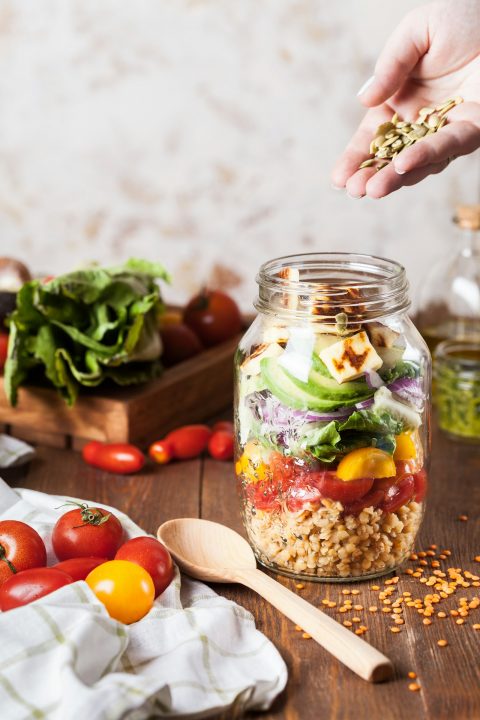
Think of the jar as a staircase that keeps wet things away from leaves. Every guide that gets this right, including Clemson Cooperative Extension, uses the same bottom-to-top logic:
- Dressing (2 to 3 tablespoons). Always first. Vinaigrettes and yogurt dressings both work.
- Hard, wet-proof vegetables. Cucumber, bell pepper, carrot, red onion, cabbage. They can sit in dressing for days and come out more flavorful, almost lightly pickled.
- Beans and grains. Chickpeas, black beans, edamame, quinoa. These soak up any dressing that creeps upward.
- Protein and soft add-ins. Chicken, hard-boiled egg, cheese, tomatoes, corn. Keep these away from the dressing so they don’t go soggy.
- Greens on top. Romaine, spinach or kale, filled to the shoulder of the jar. Press lightly; jamming them in bruises the leaves.
When it’s time to eat, shake the jar hard for ten seconds and tip it into a big bowl. Eating straight from the jar sounds charming, but you’ll get all leaves first and all dressing last.
What size jar for a mason jar salad?
Use a wide-mouth quart jar (32 oz) for a lunch-sized salad. Every recipe below is built for one. Pint jars (16 oz) only fit about half the greens, so save them for side salads. The wide mouth matters more than you’d think: it lets you layer neatly and actually get the salad out.
4 mason jar salad recipes for the week
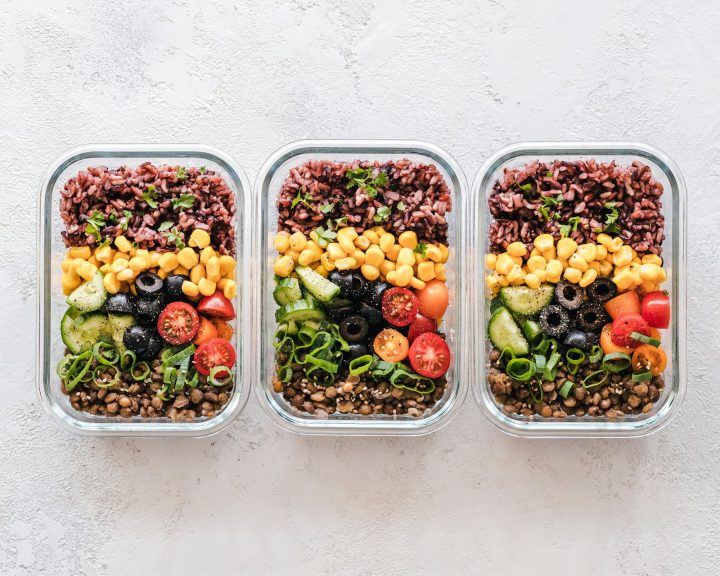
Each recipe makes one quart jar. Multiply by four for a full workweek, or make two flavors and alternate. Ingredients are listed in packing order, bottom to top. Nutrition is calculated from USDA FoodData Central values for the exact amounts listed (dried herbs, spices and vinegar left out, since they add next to nothing).
| Jar | Calories | Protein | Fiber | Keeps |
|---|---|---|---|---|
| Greek chickpea | 382 | 14 g | 9 g | 4 days |
| Chicken and egg with yogurt ranch | 418 | 50 g | 5 g | 3 to 4 days |
| Southwest black bean and quinoa | 426 | 14 g | 15 g | 4 days |
| Peanut edamame crunch | 311 | 22 g | 12 g | 4 days |
1. Greek chickpea mason jar salad
The one I make most. Feta and lemon get better after a day in the jar, and there’s nothing in it that wilts fast.
- 1 tablespoon olive oil + 1 tablespoon lemon juice + pinch of dried oregano, salt and pepper
- 2 tablespoons finely chopped red onion (20 g)
- 1/2 cup sliced cucumber (52 g)
- 1/2 cup canned chickpeas, drained and rinsed (82 g)
- 1/2 cup cherry tomatoes, left whole (75 g)
- 1/4 cup crumbled feta (38 g)
- 2 cups chopped romaine (94 g)
Per jar: 382 calories, 14 g protein, 24 g fat, 31 g carbs, 9 g fiber. Leave the tomatoes whole: a cut tomato leaks juice into everything above it.
2. Chicken and egg jar with Greek yogurt ranch
A Cobb-style jar for days when a salad has to hold you until dinner. Use leftover roast chicken or the batch from our chicken and rice meal prep.
 You’ll also loveOvernight Oats Meal Prep: 5 Jars in 15 Minutes (20g Protein)
- 3 tablespoons plain nonfat Greek yogurt + 1 teaspoon olive oil + 1 teaspoon lemon juice + dried dill, garlic powder and salt
- 1/2 cup diced red bell pepper (75 g)
- 1/2 cup cherry tomatoes, left whole (75 g)
- 4 oz cooked chicken breast, diced (113 g)
- 1/4 cup cooked corn kernels (41 g)
- 1 hard-boiled egg, quartered (50 g)
- 2 cups chopped romaine (94 g)
Per jar: 418 calories, 50 g protein, 15 g fat, 21 g carbs, 5 g fiber. The yogurt dressing is thick, so it stays put at the bottom better than oil-based ones do.
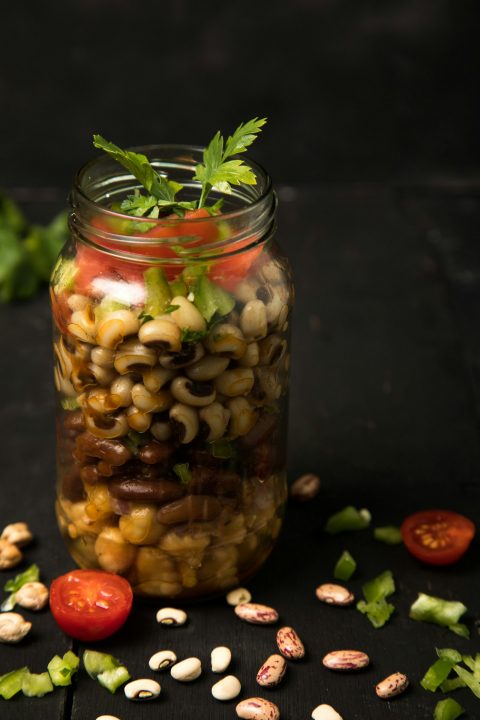
3. Southwest black bean and quinoa jar
The most filling of the four thanks to the quinoa and beans, with 15 g of fiber per jar. Salsa doubles as the dressing base, so there’s almost nothing to whisk.
- 3 tablespoons jarred salsa + 1 tablespoon olive oil + 1 tablespoon lemon or lime juice + pinch of cumin
- 1/2 cup diced red bell pepper (75 g)
- 1/2 cup canned low-sodium black beans, drained and rinsed (85 g)
- 1/2 cup cooked quinoa, cooled (92 g)
- 1/2 cup cooked corn kernels (82 g)
- 2 cups chopped romaine (94 g)
Per jar: 426 calories, 14 g protein, 17 g fat, 61 g carbs, 15 g fiber. Want more protein? Add 3 oz of diced chicken on top of the corn. Need more fiber ideas? Our high fiber meals list has a few more that pack well.
4. Peanut edamame crunch jar
Plant-based, 22 g of protein, and the crunchiest jar here. Red cabbage and carrot barely change in four days, which makes this the best pick for a Thursday or Friday lunch.
- 1 tablespoon smooth peanut butter + 2 teaspoons tamari + 1 tablespoon rice vinegar + 1 to 2 teaspoons warm water, whisked smooth
- 1/2 cup shredded carrot (55 g)
- 1 cup shredded red cabbage (70 g)
- 1/2 cup sliced cucumber (52 g)
- 3/4 cup shelled edamame, thawed (118 g)
- 2 cups baby spinach (60 g)
Per jar: 311 calories, 22 g protein, 15 g fat, 29 g carbs, 12 g fiber. Tamari is salty (730 mg sodium per jar), so taste the dressing before adding any extra salt.
How long do mason jar salads last?
Plan on up to 4 days in the fridge at 40°F or below. Some guides stretch it to five days or even a week, but by day five romaine starts to brown at the edges, and that’s before you think about the protein.
The protein sets the real limit. FoodSafety.gov’s cold food storage chart gives cooked meat or poultry leftovers 3 to 4 days in the refrigerator, and egg and chicken salads 3 to 4 days too. Hard-cooked eggs get 1 week on their own. So count the days from when you cooked the chicken, not from when you filled the jar. If the chicken was roasted on Saturday, a Monday jar is fine but a Thursday jar isn’t.
 You’ll also loveOvernight Oats with Chia Seeds: The Base Ratio + 6 Flavors
My routine: pack the two meat-free jars and the chicken jar on Sunday, eat the chicken one first (Monday or Tuesday), and save the edamame jar for last because it holds up best.
Prefer warm lunches some days? Mix these jars with the bowls from our vegetarian meal prep rotation, like sesame tofu with broccoli or sweet potato black bean burrito bowls.
How to keep mason jar salads from getting soggy
- Dry your greens completely. Water left on leaves does more damage than dressing. Use a salad spinner, then pat with a towel.
- Cool everything first. Warm quinoa or chicken steams the leaves above it. Let cooked food chill before it goes in.
- Keep cut tomatoes and avocado out. Use whole cherry tomatoes. Add avocado, nuts and croutons the morning you eat it.
- Store jars upright. A jar on its side lets the dressing run straight into the greens.
- Pick sturdy greens for day 3 and 4. Romaine, kale and cabbage outlast spring mix and butter lettuce.
If you’re new to prepping lunches, our meal prep for beginners guide covers the Sunday workflow, and the chicken meal prep ideas give you more proteins to rotate into the jars. On days you don’t have jars ready, these healthy lunches you can make in 10 minutes fill the gap.
Mason jar salad FAQ
Can you put the dressing on top instead?
Only if you’ll eat it within a few hours. On top, it drips through the greens and wilts them by the next day. If you’d rather not have dressing in the jar at all, pack it in a small separate container.
Can you freeze mason jar salads?
No. Lettuce and cucumber turn to mush when they thaw, and the FoodSafety.gov chart notes that egg and chicken salads do not freeze well.
Do I need to shake it before eating?
Yes, then pour it into a bowl. A quart jar is too narrow to toss the salad in, and shaking spreads the dressing evenly.
Sources
- USDA FoodData Central, SR Legacy entries used for nutrition: olive oil (171413), lemon juice (167747), chickpeas canned drained (173801), cucumber (168409), tomatoes (170457), onions (170000), feta (173420), romaine (169247), nonfat Greek yogurt (170894), roasted chicken breast (171477), hard-boiled egg (173424), corn (168399), low-sodium black beans (175238), cooked quinoa (168917), salsa (174524), red bell pepper (170108), edamame (168411), peanut butter (172470), tamari (174278), carrots (170393), red cabbage (169977), spinach (168462).
- FoodSafety.gov: Cold Food Storage Chart
- Clemson Cooperative Extension: Mason Jar Salads