Short answer: Yes, oatmeal is good for you, as long as you mean plain oats. Half a cup of dry oats (40 g) gives you about 152 calories, 4 g of fiber, 5 g of protein and almost no sugar. The catch is the flavored instant packets: a maple and brown sugar packet carries about 13 g of sugar. Buy plain oats and sweeten them yourself.
So, is oatmeal good for you every morning, or just a cozy habit with a healthy reputation? I eat it most weekdays, and the honest answer is that plain oats earn their reputation. They are a whole grain, they are cheap, and a bowl is filling for its calories. Where oatmeal goes wrong is almost always what gets added to it, either at the factory or at the stove.
Below are the real USDA numbers for a standard serving, how steel-cut, rolled and instant oats compare, what is hiding in flavored packets, and the easy ways I keep a daily bowl from getting boring.
Oatmeal Nutrition Facts per 1/2 Cup Dry Oats
A standard serving is 1/2 cup of dry rolled oats, which weighs about 40 g and cooks up to roughly a cup of oatmeal. These numbers come from the USDA FoodData Central entry for plain dry oats (FDC ID 173904), scaled from the per-100 g values to 40 g.
| Nutrient | 1/2 cup dry oats (40 g) |
|---|---|
| Calories | 152 |
| Carbohydrates | 27 g |
| Fiber | 4 g |
| Protein | 5.3 g |
| Fat | 2.6 g (0.4 g saturated) |
| Total sugars | 0.4 g |
| Sodium | 2 mg |
| Iron | 1.7 mg |
| Magnesium | 55 mg |
| Phosphorus | 164 mg |
| Potassium | 145 mg |
| Zinc | 1.5 mg |
| Manganese | 1.5 mg |
Two things stand out. First, plain oats are close to sugar-free and sodium-free, which is rare for a packaged breakfast. Second, the protein is decent for a grain but not high. Five grams will not carry you to lunch on its own, which is why I almost always pair oats with milk, Greek yogurt, eggs or nut butter.
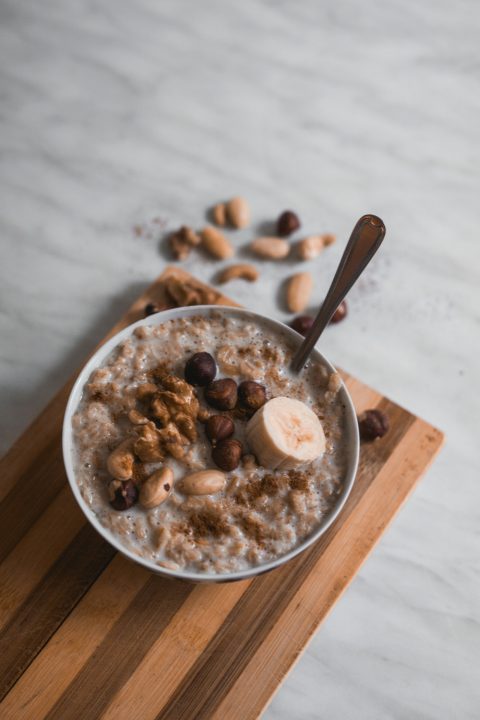
Why Plain Oatmeal Is a Good Breakfast
It is a whole grain with real fiber
Even rolled and quick oats keep the bran, germ and endosperm of the oat kernel, so you are eating the whole grain, not a refined flour. That is where the 4 g of fiber per serving comes from. Add a handful of berries or a spoonful of chia and a single bowl becomes one of the higher-fiber breakfasts you can make in five minutes. If fiber is your goal, our high fiber breakfast ideas build on exactly this.
It fills you up for its calories
Oats soak up liquid and swell, so 152 calories of dry oats turns into a full, warm bowl. Compare that with a pastry or a sugary cereal at the same calories and the difference in how long you feel satisfied is obvious. No single food makes you lose weight, but a breakfast that keeps you from snacking at 10 a.m. helps.
It brings minerals most people skip
Oats are a quiet source of magnesium, phosphorus, zinc, iron and manganese. None of them make headlines, but they add up when oats replace a refined-grain breakfast most days of the week.
It is cheap and endlessly flexible
A canister of plain oats costs less per serving than almost any other breakfast and keeps for months in the pantry. You can cook it, soak it, bake it or blend it, and it works sweet or savory.
Steel-Cut vs Rolled vs Instant Oats
All three start as the same whole oat groat. The difference is how much the groat is cut, steamed and flattened, which changes cooking time and texture far more than nutrition. According to the Harvard T.H. Chan School of Public Health, steel-cut and instant oats have similar nutrition, but less-processed oats generally have a lower glycemic index, meaning they are digested a bit more slowly.
| Type | How it is made | Cook time | Texture | Best for |
|---|---|---|---|---|
| Steel-cut (Irish) | Groats chopped into 2 or 3 pieces | 25 to 30 minutes | Chewy, nutty | Batch cooking for the week |
| Rolled (old-fashioned) | Groats steamed and flattened into flakes | A few minutes (follow the package) | Soft, flakes hold their shape | Everyday bowls, overnight oats, baking |
| Quick and instant | Steamed longer, rolled thinner | 1 to 2 minutes | Soft to mushy | Office, travel, busy mornings |
My take: rolled oats are the best all-rounder. They cook fast, they make the best overnight oats, and they bake well. Steel-cut oats are worth it if you love the chew and cook a big pot on Sunday. Plain instant oats are perfectly fine nutritionally. The problem is that most instant oatmeal sold in the US comes pre-flavored.
How Much Sugar Is in Flavored Instant Oatmeal?
This is where the “is oatmeal healthy” question gets a real “it depends.” USDA data for fortified maple and brown sugar instant oatmeal (FDC ID 173920) lists 30.3 g of sugar per 100 g. One 43 g packet works out to:
| Per serving | Plain dry oats (40 g) | Maple and brown sugar packet (43 g) |
|---|---|---|
| Calories | 152 | 166 |
| Total sugars | 0.4 g | 13 g |
| Fiber | 4 g | 3.1 g |
| Protein | 5.3 g | 4 g |
| Sodium | 2 mg | 217 mg |
The calories are similar, but the packet swaps some of the oats for sugar and adds roughly 90 times the sodium. You also get less fiber and protein. A packet now and then is not a disaster, but as a daily habit it is a sweetened cereal, not plain oatmeal.
 You’ll also loveThe Science of Eating for Focus: What Successful People Eat Before Work
The fix is easy: buy plain oats (old-fashioned, quick or unflavored instant) and add your own sweetness. Half a mashed banana, a handful of berries, cinnamon, or a teaspoon of maple syrup that you measure yourself gives you flavor with far less sugar than the packet.
Common Oatmeal Mistakes
- Toppings that outweigh the oats: Granola, dried fruit, chocolate chips and heavy pours of nut butter are fine in small amounts, but they can double the calories of the bowl. Measure them for a week to see where you land.
- No protein on the side: At about 5 g per serving, oats alone are light on protein. Cook them in milk, stir in Greek yogurt, or eat an egg alongside.
- Assuming oats are gluten-free: Oats are naturally gluten-free, but they are often grown and processed alongside wheat. If you avoid gluten, buy oats labeled gluten-free.
- Going from zero to a huge bowl: If you do not eat much fiber now, start with a smaller portion and drink enough water while your gut adjusts.
Easy Ways to Eat Oatmeal Every Day
- Classic stovetop bowl: 1/2 cup (40 g) rolled oats simmered in 1 cup (240 ml) milk, topped with berries and a spoonful of chopped walnuts.
- Overnight oats: Stir oats, milk and Greek yogurt together in a jar at night and breakfast is waiting in the morning. Pick a flavor from our healthy overnight oats recipes.
- A week of jars at once: Prep five jars on Sunday with this overnight oats meal prep plan and you are done for the work week.
- Baked oatmeal: One pan of baked oatmeal with blueberries and banana slices into squares that reheat in under a minute.
- Savory oats: Cook the oats in broth instead of milk and top with a fried egg, sautéed spinach and a little Parmesan. It tastes like a quick risotto.
- Chia oats: Add a tablespoon of chia seeds for extra fiber and a thicker texture. Our overnight oats with chia seeds has the base ratio and six flavors.
Oatmeal FAQ
Is it OK to eat oatmeal every day?
For most people, yes. Choose plain oats, keep added sugar low, add some protein, and rotate your toppings so you get a range of nutrients across the week.
Is instant oatmeal as healthy as rolled oats?
Plain instant oats are nutritionally close to rolled oats; they are just cut thinner and cook faster. Flavored packets are the issue, because of the added sugar and sodium shown in the table above.
How much oatmeal is one serving?
Half a cup of dry rolled oats (40 g), which makes about a cup cooked. If oatmeal is your whole meal and you are very active, 3/4 cup dry is a reasonable bowl.
Is oatmeal better with water or milk?
Both work. Water keeps the calories to the oats alone, while milk makes it creamier and adds protein. I use milk, or half milk and half water.