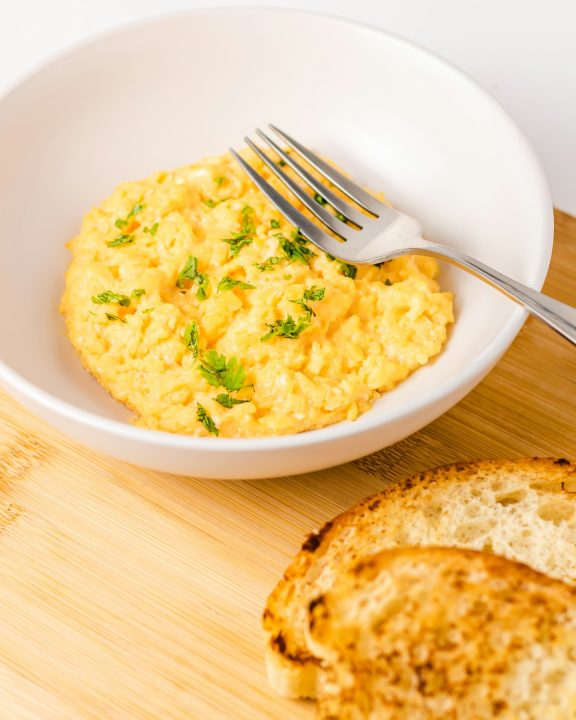
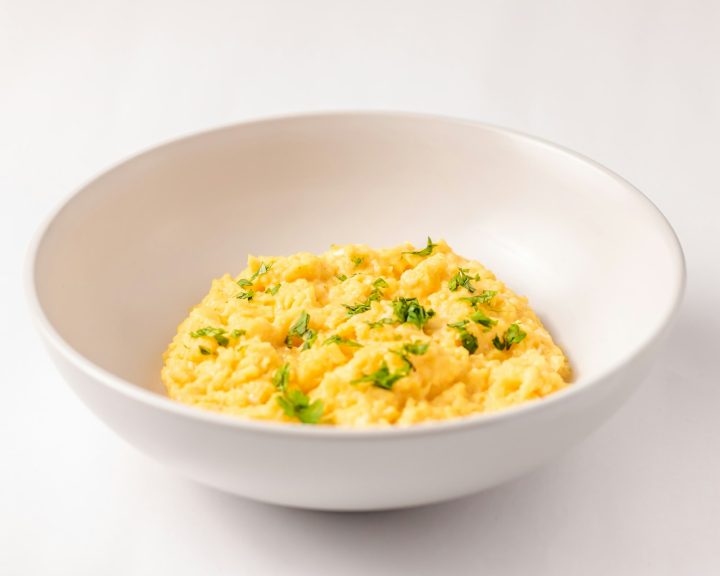
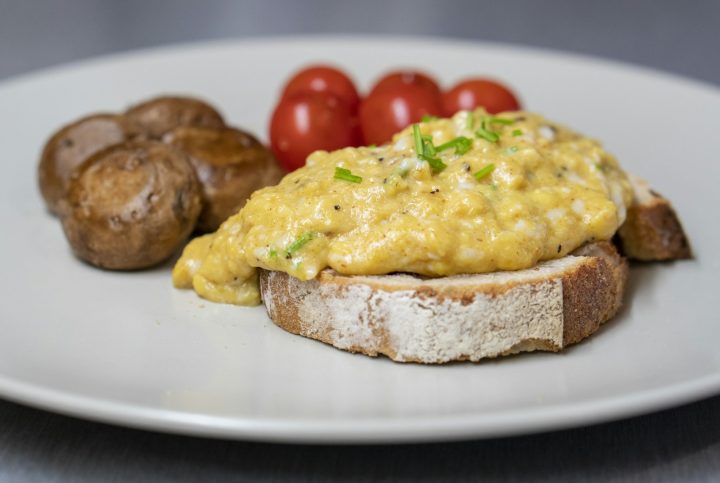
Scrambled eggs with cottage cheese taste like the eggs you get at a good brunch spot: soft, creamy and a little rich, without a splash of heavy cream. The method is simple. Whisk about 1/3 cup of cottage cheese into 3 eggs, cook them slowly in a little butter over medium-low heat, and pull the pan off while they still look glossy. Five minutes, one pan.
The cottage cheese does two jobs. The curds melt into soft, cheesy pockets, and the extra protein makes the plate more filling: about 27 g protein and 312 calories, versus roughly 19 g for the same eggs cooked plain. The only real way to ruin it is high heat, which squeezes water out of the curds. More on that below.
21 meals, 100 g+ protein a day, plus a grocery list and prep schedule.
Ingredients
Serves 1 · Prep 2 minutes · Cook 3 minutes
- 3 large eggs
- 1/3 cup (75 g) 2% cottage cheese
- 1 tsp salted butter
- Pinch of salt (optional; the cottage cheese is already salty)
- Black pepper, to taste
- 1 tbsp chopped fresh chives
Small-curd cottage cheese melts more evenly than large-curd. Full-fat (4%) works too and tastes a little richer; nonfat works but turns slightly rubbery, so I stick with 2%.
How to make scrambled eggs with cottage cheese
- Whisk the eggs and cottage cheese in a bowl until the eggs are fully broken up and a little frothy, about 30 seconds. Season with pepper and only a small pinch of salt.
- Melt the butter in a nonstick skillet over medium-low heat until it foams but does not brown.
- Pour in the eggs and let them sit for 15 to 20 seconds, until the edges just start to set.
- Push the eggs slowly from the edges to the center with a silicone spatula, making large soft folds. Keep the heat at medium-low and keep folding every few seconds.
- Take the pan off the heat when the eggs are mostly set but still look slightly glossy, about 2 to 3 minutes total. They will finish cooking on the plate.
- Sprinkle with chives and serve right away.
Per serving (3 eggs): about 312 calories, 27 g protein, 20 g fat, 5 g carbs and 476 mg sodium before any added salt. Calculated from USDA FoodData Central values for whole eggs, 2% cottage cheese, salted butter and chives.
Should you blend the cottage cheese first?
It depends on the texture you want, and both are good.
- Whisked in by hand (curds left whole): you get little pockets of melty, mild cheese through the eggs, a bit like ricotta. This is my default, and it needs no extra dishes.
- Blended smooth: blitz the eggs and cottage cheese together for 10 to 15 seconds in a blender or with a stick blender. The result is silky and uniform, closer to French-style eggs, and nobody can tell there is cottage cheese in it. This is the version to make for anyone who says they hate cottage cheese.
Blended eggs cook a touch faster because the mixture is airier, so start checking at the 2-minute mark.
Why are my cottage cheese eggs watery?
Watery eggs are the number one complaint with this recipe, and they almost always come from one of three things:
- The heat is too high. Hot pans tighten the egg proteins fast and push out liquid, and cottage cheese adds its own whey to the puddle. Medium-low is the fix.
- They cooked too long. Eggs that look dry in the pan will weep on the plate. Stop while they are still shiny.
- The tub was very loose. Some brands sit in a lot of liquid. Spoon the curds out with a fork and leave the pooled liquid behind, or let them sit in a fine sieve for a minute.
Salting early can also draw out moisture, but with cottage cheese you need so little salt that it rarely matters.
Cottage cheese scrambled eggs nutrition vs plain eggs
Here is what the cottage cheese actually adds, using the same 3 eggs and 1 tsp butter in every row:
 You’ll also loveHigh Protein Shakshuka That Packs 37 g Per Plate
| Version | Calories | Protein | Fat | Sodium* |
|---|---|---|---|---|
| 3 eggs, plain | 250 | 19 g | 18 g | 245 mg |
| 3 eggs + 1/3 cup cottage cheese (this recipe) | 312 | 27 g | 20 g | 476 mg |
| 3 eggs + 1/2 cup cottage cheese | 343 | 31 g | 21 g | 593 mg |
So 1/3 cup of cottage cheese adds about 8 g of protein for roughly 60 calories, which is a good trade if you want breakfast to last until lunch. The catch is sodium: it nearly doubles, which is why this recipe tells you to go easy on the salt shaker. If you are curious how this compares with an egg-white scramble, our breakdown of whole eggs vs egg whites has the numbers.
Cooking for a lighter appetite? Two eggs with 1/4 cup (about 50 g) of cottage cheese and the same butter comes to about 219 calories and 18 g protein.
5 easy mix-ins
Add these to the pan just before the eggs, or fold them in during the last 30 seconds:
- Spinach: wilt a big handful (about 30 g) in the butter first. It adds only about 7 calories and almost a gram of fiber.
- Everything bagel: skip the chives and finish with a sprinkle of everything bagel seasoning. Leave out the salt entirely, since the seasoning brings its own.
- Tomato and basil: fold in a few halved cherry tomatoes and torn basil off the heat.
- Smoked salmon and dill: lay a few strips on top of the finished eggs with fresh dill. Very brunch, very little effort.
- Southwest: sauté a little diced bell pepper and onion first, then top with salsa and hot sauce.
What to serve with cottage cheese eggs
Toast is the obvious partner. A 30 g slice of whole-wheat bread adds about 76 calories, 4 g protein and 2 g fiber, which also fills the fiber gap, because eggs and cottage cheese have essentially none. Spoon the eggs straight onto the toast with a little avocado, or tuck them into a warm tortilla with salsa for a quick breakfast taco.
Fruit on the side works well too: a handful of berries or an orange balances the salty, savory plate. If you like this kind of breakfast, you will probably like our other high protein recipes for breakfast, and if you have extra cottage cheese to use up, try the 15-minute cottage cheese pizza bowl for lunch.
Can you make them ahead?
Scrambled eggs are best straight from the pan; reheated, they firm up and can turn a little watery. If you want an egg breakfast you can prep on Sunday, bake the same idea into egg muffins instead: they use cottage cheese too and reheat in under a minute.
Feeding a crowd or prepping for the whole week? The same eggs-plus-cottage-cheese combo bakes into one pan in our cottage cheese egg bake, which cuts into 8 squares that reheat in under a minute.
 You’ll also loveStuffed Acorn Squash With Turkey, Quinoa and Sage
If you do have leftovers, cool them quickly and refrigerate. FoodSafety.gov’s cold storage chart doesn’t list scrambled eggs on their own; its closest entry, casseroles with eggs, is 3 to 4 days in the fridge after cooking. Reheat gently in the microwave in 15-second bursts. Raw eggs in the shell keep 3 to 5 weeks in the fridge, so you can buy a big carton without worrying.
Quick questions
How much cottage cheese per egg?
About 2 tablespoons (25 g) per large egg is the sweet spot. You can push it to 1/2 cup for 3 eggs if you want more protein, but the eggs get looser and need an extra 30 seconds in the pan.
Does it taste like cottage cheese?
Barely. Whisked in, it tastes like mild melted cheese. Blended, it just tastes like extra-creamy eggs. Cottage cheese is a lean, high-protein cheese, and you can see how it ranks against others in our high protein cheese list.
Can I use Greek yogurt instead?
You can stir a spoonful in at the end for creaminess, but it doesn’t melt into curds and turns tangy when heated, so the result is different. Cottage cheese is the better choice here.
Sources
- USDA FoodData Central via getfoodfacts.com: Egg, whole, raw, fresh (FDC 171287), Cheese, cottage, lowfat, 2% milkfat (FDC 172182), Butter, salted (FDC 173410), Chives, raw (FDC 169994), Spinach, raw (FDC 168462), Bread, whole-wheat (FDC 172688)
- FoodSafety.gov: Cold Food Storage Chart

Scrambled Eggs With Cottage Cheese
Ingredients
- 3 large eggs
- 1/3 cup (75 g) 2% cottage cheese
- 1 tsp salted butter
- Pinch of salt (optional; the cottage cheese is already salty)
- Black pepper, to taste
- 1 tbsp chopped fresh chives
Instructions
- Whisk the eggs and cottage cheese in a bowl until the eggs are fully broken up and a little frothy, about 30 seconds. Season with pepper and only a small pinch of salt.
- Melt the butter in a nonstick skillet over medium-low heat until it foams but does not brown.
- Pour in the eggs and let them sit for 15 to 20 seconds, until the edges just start to set.
- Push the eggs slowly from the edges to the center with a silicone spatula, making large soft folds. Keep the heat at medium-low and keep folding every few seconds.
- Take the pan off the heat when the eggs are mostly set but still look slightly glossy, about 2 to 3 minutes total. They will finish cooking on the plate.
- Sprinkle with chives and serve right away.
Nutrition per 3 eggs
21 meals, 100 g+ protein a day, plus a grocery list and prep schedule.